Showing posts with label Virginia. Show all posts

Tuesday, October 22, 2024

Punishments In Old Virginia


Reading Ulysses P. Joyner's The First Settlers of Orange County, Virginia, I thought to share bits about early forms of punishments there and the reasons for such punishments. 

Reasons for punishment in the early 1700s included: killing a slave, stealing a horse, absenting oneself from church, illicit cohabitation/adultery, failure to pay taxes, insulting the minister,  failure to keep his appointed stretch of road in good repair. having a "base born" child, drunkenness, stealing, murder, disturbing the peace and being a vagabond.

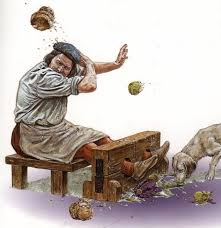
Punishments included:  time in the stocks (either the stand-up or sit-down sort). "This was a form of public ridicule and humiliation since the prisoner's ankles, wrists and neck were shackled in the stocks on the courthouse lawn and the public gathered to taunt him/her." 

Those convicted of stealing would have one or both of their ears nailed to the pillory for a specified time at the conclusion of which the sheriff used his sword to cut the sorry soul loose, leaving the ear affixed to the pillory.

Though women criminals were often dealt with as harshly as men, the usual punishment imposed on women for minor offenses was the "ducking pool" or "dunking stool." The lady was placed on the stool attached to the end of a long pole in a public area and was "ducked" or dunked in a pool of water, a spectacle enjoyed by all except the victim.

As I read these pages, I was stuck by how much the idea of public humiliation was part of the punishment. Yes, loosing an ear was painful and awful but being put on display as a criminal was likely just as painful for the victim. I personally think that using thirty minutes in public stocks would be great punishment for minor offenders today.

Tuesday, July 2, 2024

A Bit of Virginia History


(Map of Virginia in 1600 from Alamy)


Once upon a time, all of North America between Florida and Nova Scotia was known as Virginia for a number of years .......... did you know that? The area was named by Queen Elizabeth (ruled 1558 to 1603) after herself as "the Virgin Queen." She charmed by Sir Walter Raleigh's, her favorite sea captain,  accounts of the coasts of the Carolinas in 1585 that she favored him by taking his suggestion for a name of this new land. 

True or false? I found this bit in a book, The History of Orange County Virginia, by William W. Scott, published in 1907.

I spent a bit of time digging into this recent reprint looking for information on my Orange County ancestors. Like with many checked-into sources, I found no real answers but several clues. (Isn't that what real research is all about???)

I did find these rather amusing names:

Prettyman Merry, "a prominent citizen during the Revolution"

Mourning Pegg,  found on the 1782 census

Peachy Bledsoe, in 1792 a Regimental Sgt. 

Tuesday, May 24, 2022

Think All County Boundaries Are Long Finalized?


We genealogists learned long ago that the early Colonial Americans sometimes measured land by chains...... can you imagine hauling and stringing out heavy chains up and down the Appalachian Mountains? 

Well, that's why a 16-mile stretch of the boundary between what is now West Virginia and Virginia was never properly surveyed. Lying atop the crest of the Blue Ridge, it was just too rugged a terrain to measure and besides, "everybody knew where it was."

Thanks to an article in a 1997 National Geographic magazine, I learned that this particular stretch was at long last and finally surveyed in 1996. 

Why did this finally matter so much? "People were moving into the area, sending their children to school, and expecting fire and police protection from "their" state," so which one was it???

Bet you thought you knew that answer, right? :-) 

Wednesday, October 3, 2007

Virginia Tithables 1624 - 1704

All researchers should use tithable lists, which were annual head taxes that were levied on residents. Because land and personal property were generally NOT taxed in the early colonies, the tithable lists are about the only colonial period tax records we can use.

There were acts setting the amount of tax in 1629, 1632 and 1639 and the word "tithable" does not appear in the law statutes until 1643. As counties and parishes were established, there was naturally a need to collect revenue, therefore making subsequent statutes necessary, in order to define all factors. There were various acts from 1643 through 1748 and the main thing was to identify the people, not in a physical household, but rather a taxable one.

Still, existing lists may be county lists or even parish lists which could be originals, copies, or lists that were actually entered by the county or vestry clerk. The origins of the list, therefore, determines the likely accuracy and we must keep in mind a justice's list or a clerk's list may very well spell the same name differently.

As the colonies became independent, the tax system changed to taxing mainly males over 16 as well as to taxes on personal property and land. If you are researching Virginia, it is a good idea to check "The Statutes at Large: Being a Collection of All the Laws of Virginia" by Wm. W. Hening, editor. Vol. 1, p. 128. You need to carefully check the applicable laws and the county clerk records to interpret tithables lists made during the period of interest.