Showing posts with label Family Tree Magazine. Show all posts

Tuesday, November 4, 2025

Family Tree Magazine, Best Bet!


FamilyTree Magazine is my go-to-tutorial these days for holding-in-my-hands genealogy learning. I like "real" books; I like "real" magazines. If you do too, FT is for you!

For example, in the July-August 2025 issue there were articles on these topics:

  • Ancestry.com has a digitized book collection! This includes local histories, directories, memoirs and more. Click to www.ancestry.com/search/collections/catalog and then search by title or keyword. (This is NOT a link; copy and paste it.) 

  • Annual list of 101 Best Genealogy Websites; marked if free or pay and whether first time on the list or was on previous lists. What a glorious guide!

  • "Signs of Life" was an article offering to "re-energize your efforts for strategies to access vital records."

  • I've read where most men in the late 19th century belonged to a Masonic lodge. Our ancestors were joiners and not just for the comradeship but for financial support to each others' families in times of trouble. So likely YOUR ancestor belonged to some fraternal organization. This article lists the basics of searching for such records.

  • Sunny Jane Morton is a regular (and top notch!) contributor to Family Tree Magazine. Her article in this issue on how to really evaluate and use the millions of new records' hints that are appearing on the major genealogy websites all the time. She offers 12 good tips on understanding this resource. 

  • DNA Ethnicity Estimates. This was the back page article by DNA expert, Diahan Southard. The submitted question was "why do my DNA ethnicity estimates keep changing?" How come last year my test showed I was 25% Swedish and this year it says I'm only 15%? What gives? Diahan wrote: "Think of it like this: When trying to match a paint color, you'll have a harder time with just THREE paint swatches than if you had 300. That's exactly what's happening with DNA testing. DNA testing companies are constantly expanding their reference panels (their paint swatches, if you will) to give you more accurate results." 

Friday, October 3, 2025

Civil War Research


Tomorrow is the EWGS Fall Workshop with the spotlight on Civil War Research. F.Y.I. Family Tree Magazine offers this 8-page, laminated, Cheat Sheet to help you "find military records and study the history" of the Civil War. Cost for this is $14.95, + p/h. This Cheat Sheet offers

5 Steps to Trace Your Civil War Ancestor:

1. Search the Civil War Soldiers & Sailors (CWSS) Database.... a free National Park Service site which indexes over 6,000,000 soldiers and 18,000 African American sailors. 

2. Obtain service and pension records (explains how).

3. Find burial information. (National cemeteries were established in 1862 for the Civil War dead.) 

4. Seek additional records (explains what/where).

5. Broaden your knowledge (gives great ideas). 

This Cheat Sheet then gives two pages explaining in more detail what the records contain. Also a map of the U.S. during the Civil War (Did you know that Oregon remained loyal to the Union?) and a Civil War Timeline (helps greatly to understand that conflict). The final page of this Cheat Sheet lists 17 websites and 24 books for your further study. 

One resource listed was The Civil War, a film by Ken Burns. I've viewed this; it's worth a second time around, especially if you have ancestors who participated in the Civil War.

Friday, September 12, 2025

Castle Garden: Another Look


Before Ellis Island in New York harbor, there was Castle Garden. Let's look again:

  • Castle Garden as immigrant station opened in 1855
  • Certainly there were immigrant arrivals prior to that year
  • What became Castle Garden was a military fort from 1808-1855
  • After Castle Garden closed as an immigrant station, it became an entertainment center
New York officials realized by 1819 that "immigration was anything but organized." There were several proposals for a solution; that solution was to use Castle Garden. Remember it was first a military fort and then entertainment venue and did not become an immigrant arrival station until 1855. It opened on 3 August 1855. 

  • Roughly 2 out of every 3 immigrants to the U.S. between 1855 and 1890 (approximately 8.5 million people) passed through Castle Garden.
  • But the place was not really equipped to handle such crowds; "overcrowding and understaffing led to scenes of confusion and congestion that became infamous in their own right." 
  • By the 1880s it was obvious that a new solution must be found.
  • After much verbal wrangling among New York politicians, the Federal Government had had enough and in February 1890 New York officials were told the news. 
Castle Garden officially closed its doors on 18 April 1890; in its final years, it processed 364,086 immigrants. By year's end, the building was transferred back to the city. The Barge Office was used as the immigrant arrival center between 18 April 1890 and 31 Dec 1891 while construction on Ellis Island was complete. The new facility on Ellis Island began receiving immigrants on January 1, 1892. Over the next 62 years, more than 12 million immigrants would arrive in the U.S. via Ellis Island.

Where are the Castle Garden records?
  • Unfortunately, some of the CG records were lost in a fire that burned Ellis Island to the ground in 1897 but many still exist. 
  • Check with FamilySearch.org
  • Check with Ancestry.com
If you type: Castle Garden Immigration: A Genealogist's Guide, by Katharine Andrew, offered free on the FamilyTree Magazine website, you'll get all your Qs answered!


Tuesday, January 30, 2024

Google for Genealogy


Google should be one of the most-used tools in your genealogy tool box. The "wag" is that you can ask Google for information on a zillion subjects. (No, Google will NOT be able to tell you where great-grandma was buried.)

Family Tree Magazine offered this 8-page Cheat Sheet as an insert in their magazine a while back. My opinion? It's worth the $9.99 but ONLY IF you use it! 😐

Here are the front page Google Search Tips:

  • Save time; search properly
  • Disregard punctuation
  • Disregard capitalization
  • Don't stress spelling
  • Put the most important search term first
  • Use the Advanced feature
  • Set up Google alerts/automated searches
  • Use Google Chrome
Did you know Google offers (for free):
  • Google Books, 40 billion books
  • Google Translate
  • Google Maps
  • Google Earth
  • Google Drive
  • MORE!
There are dozens of tutorials on YouTube (also part of the Google family) to teach you!

Genealogical research is more than just picking the "low-hanging fruit" and sitting back. Genealogical research is learning how to reach that "higher" fruit!  Google can help, I guarantee. 😀

Friday, November 3, 2023

FREE: Genealogy Brick Wall Busters!


Stuck in your genealogy research? In this free ebook, our experts show you ways to overcome some typical (but still frustrating) research challenges.


Family Tree Magazine offers all sorts of good stuff, some for pay and many for FREE. Such is this offer........ a 32-page guide that can be yours for FREE to download.

This book is comprised of reprinted articles from the FT Magazine, all helpful, insightful and How-I-Did-It articles. Why not go see..... it's FREE! We can always learn something new and a review is also always helpful.

While your at the www.familytreemagazine.com website, check out their other offerings and consider subscribing............. why not give yourself a November treat? 

Tuesday, September 20, 2022

Websites for Learning Social History


Big thanks to the July/August 2022 issue of Family Tree Magazine for this information.

Why do we want to learn about social history? What has it to do with genealogy? It has everything to do with our family history! Genealogy is the facts. Social history gives the why-when-how of those facts. When I learned that my great-grandmother took her 8-year-old daughter (my grandmother, Clara) upstream on the Mississippi River to visit family in St. Louis, I wanted to know more about the circumstances of that story. THAT'S social history. 

We've probably all used Google to find images of what life was like for our ancestors in any past time period or place. That's well and good, but there are other website you might consider:

** Encyclopedia Britannica - yes! No more a groaning load of huge volumes on our living room shelves, but all online AND up to date!  (www.britannica.com)

** Food Timeline  (www.foodtimeline.org). What your ancestors ate, and how they fixed their food, tells you much about their daily lives.

**History Net (www.historynet.com). Search for U.S. history topics at this website from the California Gold Rush to D-Day.

**Immigration to the United States, 1789-1930... really long website address:
library.harvard.edu/collections/immigration-united-states-1789-1930
This Harvard Library resource allows you to search among thousands of digitized books, pamphlets, periodicals, manuscripts and photos to learn more about voluntary immigration to America.

**Library of Congress Digital Collections (www.loc/gov/collections). This site includes Chronicling America (the only US newspaper resource) and more. 


At the bottom of the article was this banner bit:  "Read Shelley K. Bishop's list of free social history website, categorized by subject at 
www.familytreemagazine.com/history/top-social-history-websites

There is ALWAYS more to learn about the lives and times of our ancestors. 


Tuesday, June 7, 2022

Military Records Field Manual: New Resource


Family Tree Magazine's new book offering is this, the Genealogist's Military Records Field Manual. Surely you have ancestors who served their country in wartime? Here is a brand new resource to help you find records of that service. 

It's NOT a "book-book" but an eBook, which means you purchase it, then download it to your computer. Then you can print it out or not. This is the newest and better way to offer resource books for in this format additions and corrections are easier to do. 

Click to the Family Tree Magazine website to order this eBook. (I copied/pasted the blurb; the links shown here are NOT active.)


Friday, February 25, 2022

Emigration/Immigration..... Needing Help?


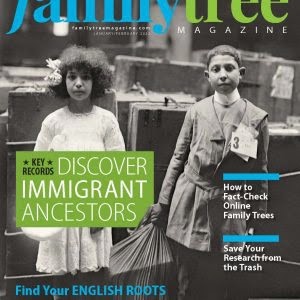
The Jan/Feb 2022 issue of FamilyTree Magazine will be uber-super helpful for those family historians beginning to struggle with emigrant and immigrant ancestors. 

(Did you know: emigrant meant "leaving" while immigrant meant coming. They emigrated from Norway and immigrated to Chicago.)

The very first article, "First Generation," reads: "Make these three kinds of records your first stop when researching your immigrant ancestors." And what are those three kinds? (1) Passenger Manifests and Customs Lists;  (2) Naturalization Records; (3) Alien Registration; and then (4) Other Records. The magazine gives ten pages to explaining the points of those records. 

Other pertinent "good stuff" in this issue includes:

**** Information on the soon-to-be-released 1921 British censuses
**** 7 tips for fact-checking online family trees
**** Discovering your ancestor's occupation
**** Create a "genealogy will" outlining for your heirs what you'd like for your research after you've passed on

At the very least, click to the FamilyTree Magazine website and sign up for their FREE updates, blog and newsletters. Why not???


Friday, November 29, 2019

Best Genealogy Periodical: Family Tree Magazine


If I were asked to recommend my candidate for best (meaning most useful) genealogy magazine, Family Tree Magazine would be my choice, hands down. 

Family Tree Magazine is published six issues per year and subscription costs $25 (less for a digital subscription). Each issue is chock-full of useful ideas and resources. Couple times a year they have lists of "75 Best Genealogy Website for ____" Could be U.S. research, could be state-by-state resources, etc. Each issue has Collectible State Guides that easily pull out from the center of the magazine. The Dec 2019 issue featured New York and North Dakota. There are dozens of other regular features always worth my time to read.

What are your kids getting you for Christmas?????? Wouldn't you like this better than a sweater??

Call 888-403-9002 to subscribe or send an email to familytree@emailcustomerservice.com


Friday, April 19, 2013

Eastern Washington Genealogical Society Blog Named as One of FTM's Top 40 Genealogy Blogs!


The Eastern Washington Genealogical Society blog has been honored, once again, to be named as one of Family Tree Magazine's Top 40 Genealogy Blogs! We are in respected company as one of six genealogical organizations so chosen: the Brooklyn Historical Society blog, NARAtions (the National Archives blog), New York History, Sandusky History, and Seeking Michigan. To view the other 34 blogs who are named as recipients of this annual award, please read the article on the Family Tree Magazine website.

The EWGS blog is co-written by the society's current president, Donna Potter Phillips; the society's researcher, Charles Hansen; and the Rest Stop Fundraiser Chairperson, Miriam J. Robbins. All three have personal genealogy blogs of their own (click on their linked names to learn more). The EWGS blog was honored in 2011 to receive this award for the first time. Thank you to all those who nominated our blog for this award.


Thursday, February 26, 2009

Washington State Named Second Best

Washington State was named the second best state in the country for genealogy in Family Tree Magazine (May 2009). Massachusetts came in at No. 1, thanks to its Mayflower passenger list and the New England Historic Genealogical Society.

The article says, “Washington ranks No. 2 on our best list – but with a footnote: Next time, we wouldn’t be surprised to see it rise to No. 1.”