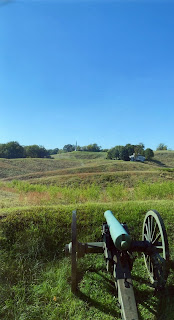
On this trip down the Mississippi, I carried a small notebook and scribbled notes furiously. Visiting this national park, I was especially overcome by the enormity of this battle. The notes are mine and the facts as I understood from our guide.
After the battle, some 17,000 Union dead were buried in a cemetery near the battlefield, now part of the Vicksburg National Park. We were told that the upright stones were for the identified soldiers and the “stubby flat” stones were for the 13,000 unidentified. The Confederate dead were buried in trenches.
The Vicksburg National Military Park was established on 21 February 1899 to preserve and protect the areas associated with the defense and siege of Vicksburg. The park covers over 1800 thousand acres. During the battle, the hills were stripped of trees. During the 1930s, the CCC men replanted many trees. In 1917, veterans were invited to return to the site and point out just where their units stood and fought and some 8800 showed up! Markers were placed at these designated sites.
As men came from 28 of the then 34 states, each participating state was invited to place a monument at the Park. Each state monument is planned and paid for by the state and then given to the Park to be placed. Most Union monuments were erected by World War II. The Confederate states’ monuments were placed much later (they were financially decimated remember). Some Southern states have yet to place a monument; neither has Vermont.
Vicksburg Trivia:
I've read that more Americans died in the Civil War than all other American wars combined; the slaughter was that terrible.
The Confederate President was Jefferson Finis Davis….. he was the last of ten children; hence the “Finis.” His only descendant was a granddaughter.
Mary Todd Lincoln’s brother, David Todd, fought for the Confederacy.
Often the Union and Confederate lines were “merely a stone’s throw apart.”
The average age of the Civil War soldier was 27.
The northwestern part of Virginia pulled early from the Confederacy to fight for the Union; this was 18 months before West Virginia became a state in 1863.
Kentucky and Missouri were split states…….. men from these states fought for both sides.
The Illinois monument, modeled after the Roman Pantheon, has sixty unique bronze tables lining its interior walls, naming all 36,325 Illinois soldiers. Our guide explained that it was erected in 1904 when the citizens of Illinois taxed themselves to finance the project.
The Alabama monument, placed in 1953, is the only one showing a “fighting” woman. It was meant to show the women’s support of their men during the conflict.
When Grant realized that the Confederates were filling their canteens from a certain creek, he dumped dead animals into that creek to pollute the water; it worked and caused many a Confederate to die a miserable death.
Joke: Difference between a Confederate and Union cannon? The way it’s pointed! So quipped our tour guide.
While I did thoroughly enjoy learning the history of the Mississippi River and its connection to the Battle of Vicksburg, I certainly did realize I was treading and viewing hallowed ground when I was privileged to visit the Vicksburg National Military Park during my cruise on the Mississippi River (from St. Paul to New Orleans) in October 2022.